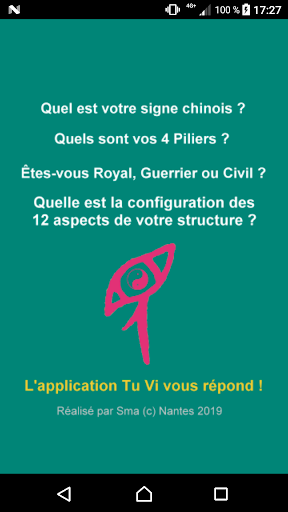
Astrologie Chinoise - Tu Vi
SmaEntertainmentGoogle Play$9.99Astrologie Chinoise - Tu Vi revenue and downloads, last 30 days
How we got this (7 inputs)
- signals
- paid price × downloads (paid sales only; in-app purchases not counted)
- method
- paid sales only; in-app purchases not counted
- range
- 80% interval from out-of-fold residuals (×1.12 scale, 90 products)
- likelyLow
- 3.93
- likelyHigh
- 14.47
- confidence
- medium
- observed days (of 30)
- 4
As of Nov 21, 2026.
How we got this (14 inputs)
- signals
- Play installs ÷ age; lifetime→current drift ×/÷4.12 (135278 measured Play counter deltas)
- spread
- measured on downloads ground truth (downloads ground truth: 48 App Store milestones, 33 platform splits, 13 drift points)
- installs
- 53
- age days
- 2806
- note
- install counter did not move in 2.63 day(s); the counter moves in steps, so this is not read as zero
- bound
- at most the lifetime installs counter (53) over 30 days: the listing is 2806 days old, so its last 30 days cannot hold more installs than it ever had
- range scale
- ×0.88 (coverage scale on 9 ground-truth rows; publication is decided before it)
- likelyLow
- 0
- likelyHigh
- 2
- confidence
- low
- rough
- order of magnitude
- observed days (of 30)
- 5
- measured days
- 0
- scaling
- observed days, scaled to 30
As of Nov 21, 2026.
Active users: not estimated for this app (too uncertain to show).
History
Daily readings as we observed them, last 30 days worldwide. Free shows the last 30 days.
Downloads per day
Observed by us since Nov 16, 2026.
Revenue per day
Observed by us since Nov 16, 2026.
Installs, Play counter
Observed by us since Nov 16, 2026.
Monthly history: we have found no public-archive copy of this store page from the last 12 months, so monthly readings start with our own in Nov 2026.
Create a free account to save apps; Pro shows full history.
Chart positions
Where this app ranks on the top free, paid and grossing charts we capture.
Search terms
No search terms read for this app yet. Terms are read from its title and the searches it shows up in, and appear here once ranked.
In-app purchases
Prices
In-app purchase ladder, price changes and paywall terms
No in-app prices recorded yet. We read them from the store listing: either this app sells none, or its listing has not been read yet.
Ratings and reviews
Rating distribution
No rating distribution read yet.
Recent reviews
Marketing
Paid ads, organic videos and onboarding captured for this app.
Paid ads
No Meta, Google or TikTok ads tied to this app yet. We check the public ad libraries daily.
Change history
Versions, price changes, rank jumps and listing edits, as we observed them.
Details
- Developer
- Sma, 2 apps
- Package
- com.chaquo.python.calendrierchinois.full
- Category
- Entertainment
- Price
- $9.99
- Released
- Mar 17, 2019
- Updated
- Aug 11, 2025
- Version
- Full-full
- Size
- -
- Content rating
- Everyone
- Website
- www.tuvi.fr
- Contact email
- sma@oceanet.fr
- Privacy policy
- www.tuvi.fr/politique-de-confidentialite/
- Languages
- Not available
- Charted in
- United States
- First seen
- Nov 16, 2026
- Listing read
- Nov 19, 2026
Show store descriptionShow less
Chinese Astrology - Tu Vi, is one of the rare Android applications to build an authentic Chinese astrological chart. It complements the PC/MAC application accessible here: https://www.tuvi.fr/ - automatically converts the legal time of birth into solar time (integration of historical Summer/Winter offsets, correction according to place of birth), - calculates the Chinese lunisolar sexagesimal calendar, with automatic determination of the intercalary moon for years of 13 lunations, - determines the 4 Pillars (Ba Zi - signs of the year, month, day and hour), - determines the psychic nature of the native (Royal, Warrior, Civilian), - places the 111 Stars on the 12 Palaces of the Chinese theme according to the date and place of birth, - restores the principle meaning of each star and their symbolic meaning according to their placement - restores the interpretation of each of the 12 aspects of the native's personality (represented by the 12 Palaces) according to the placement of the stars. - offers 3 prospective analysis methods. Method of decades, method of moving stars, method of portals. What is a Chinese birth chart? A Chinese astrological chart restores a synthetic and principled representation of the deep nature of an individual. This science of being comes from the metaphysical doctrine of Unity of the Far Eastern tradition called Taoism. It considers the luminaries (the Stars) not as agents of influence but as indicators marking out the rhythms of the diversity of the modalities constituting Universal cohesion. It distinguishes between three types of luminaries, those constituting the stellar background embodying through their mutual immobility the immutability of the Principles, those having relatively erratic movements compared to the constellations embodying the changing movements of feelings, finally the two complementary luminaries the Sun and the Moon embodying Active Perfection and Passive Perfection respectively, which are then broken down into two principles Yang and Yin. An individual being is seen as a particular movement and a distinct self proceeding from a sort of intelligible and discernible aggregation of constituent elements marking a provisional intersection between two universes with their own rhythms, namely the Macrocosm and the Microcosm. Chinese Astrology is based on a luni-solar calendar and uses the 7 stars of the constellation Boisseau (Teou corresponding to the Big Dipper) as a cosmic reference clock. The Tu Vi software is based on the calculations and principles given by Vo Van Em & François Villée in their book “The True Chinese Astrology” from Editions Traditionnelles. The positioning of the stars follows the method of Mr Nguyen Ngoc Rao.
More like this
- Top Entertainment on Google Play by estimated revenue
- Astrologie Chinoise - Tu Vi alternatives
- Astrologie Chinoise - Tu Vi vs 蓮ノ空 Live Photo Collection
- Astrologie Chinoise - Tu Vi vs 펀네이션 - Funnation
- All top charts and categories